Amir Ghalenoei took the job in 2023 with a domestic CV heavy on Iranian league titles and a reputation for pragmatic, defence-first football, and he inherits a generation that has now reached its seventh World Cup without ever clearing the group stage. A FIFA ranking of 21 makes Iran the highest-placed Asian side heading into 2026, comfortably above where they sat in their 1998 debut or the 2014 cycle, and qualification was again secured with room to spare. The expectation gap is the familiar one: a federation and public that want a first knockout appearance, and a coach whose cautious instincts suggest survival will be prioritised over spectacle.
Key players
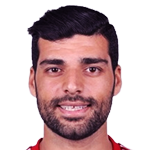
Mehdi Taremi remains the reference point, the one starter whose output translates directly to the World Cup stage. The Olympiacos centre forward has 13 goals and 5 assists in 34 appearances this season, with 69 shots and 141 duels won underlining a workload that goes well beyond finishing — he drops, holds and creates, registering 34 key passes and seven big chances. Behind him, Alireza Beiranvand offers a settled presence in goal, 34 saves across 25 appearances for Tractor Sazi suggesting the form that earned him the gloves is intact. The most interesting reserve question concerns Alireza Jahanbakhsh, now at Dender and used sparingly with 900 minutes across 21 outings; his 1.8 xG from 19 shots hints at the threat he still carries when called from the bench, though he sits behind Mohammad Mohebi in the pecking order on the right. Iran's ceiling, as ever, is tied to how much Taremi can drag from a supporting cast still finding its level.
Predicted XI


Form going into the tournament
Ghalenoei has settled on a 4-2-3-1 built around containment and vertical release rather than sustained possession. The double pivot of Ezatolahi and Ghorbani shields a back four that defends in a mid-block, conceding territory to keep the line compact and intact, and the press only triggers when the ball is funnelled wide. Transitions are the point: win it, find Taremi's feet or run the channel, and let Ghayedi and Mohebi attack the half-spaces. Ghoddos as the nominal ten drifts towards whichever flank has numerical advantage. Two questions linger. The right-back slot is genuinely contested between Rezaeian, Yousefi and Hardani, each offering a different balance of overlap and discipline. And the system's vulnerability is familiar — once the block is bypassed centrally, the recovery pace behind it is modest.
Team form
Iran's group opens against New Zealand (FIFA 85) on 16 June, the kind of fixture that should yield three points if the front line converts at a reasonable rate. Then comes Belgium (9) on 21 June, comfortably the toughest assignment of the first round and one where containment becomes the realistic ambition. Egypt (29) on 27 June looms as the decisive evening, a near-peer matchup that will likely settle second place. Knockout pairings depend on group order and the third-place permutations, but our model has Iran advancing and then projected to face France in the Round of 32 — a tie that would, on form, end the run. Predicted finish: Round of 32. Success means reaching that stage; failure to escape the group, given this draw, would register as a clear disappointment.
Country-form leaders










Club-form leaders



Group stage
Group fixtures