
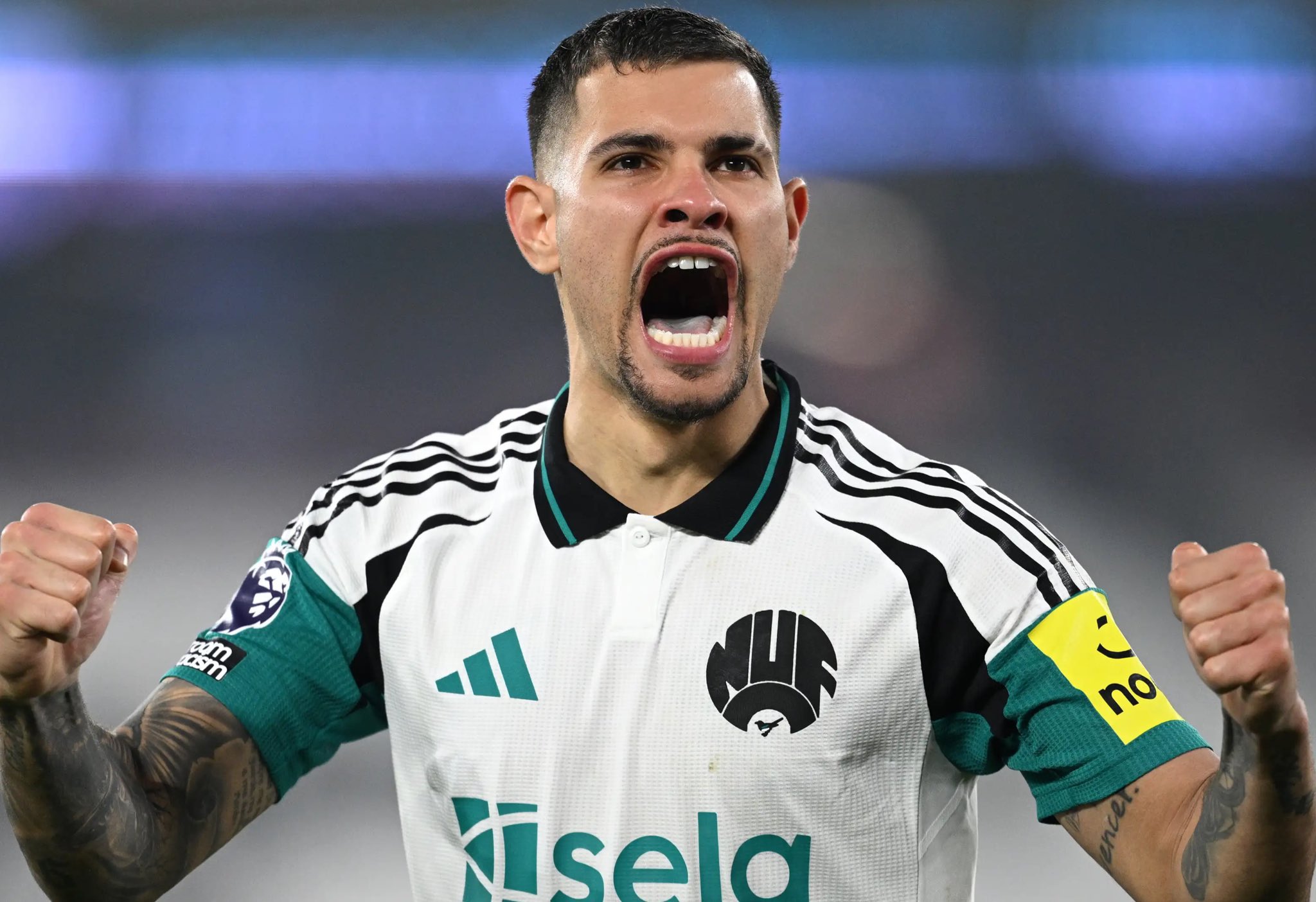
The reigning Premier League champions have a problem most clubs would envy: how to improve a midfield that already won the title. Goal.com reports that Arsenal have opened exploratory talks with Bruno Guimarães's representatives, with Mikel Arteta identifying the 28-year-old Brazilian as a midfield reinforcement and Newcastle United bracing for a formal offer this summer. That detail matters because of what Guimarães represents on Tyneside. He is the heartbeat of the side, a player whose €63.75m valuation undersells his standing in the dressing room and the structure of the team built around him. For Newcastle, losing him would be the kind of sale that defines a window and reshapes a project. For Arsenal, prising him loose would be a statement about how high they intend to set the bar. This is a transfer story, but underneath it sits a simpler question worth examining closely: how good is Bruno Guimarães now?
The profile in numbers
Across 3,200 minutes and 41 appearances, Bruno Guimarães returned nine goals and seven assists, and the underlying numbers say that scoring rate is largely earned: 0.21 xG per 90 — the quality of the chances he gets — sits just below his 0.23 goals per 90, so there's no great overperformance flattering him. The pizza wheel, measured against 96 central and defensive midfielders, frames the rest. His attacking output ranks high — 96th percentile for goals (0.33) and 94th for xG (0.25) — and his creation is genuine, 88th for key passes (1.68 per 90, the passes that create a shot for a teammate). He is heavily involved, 85th for touches (73.6, a proxy for how much play runs through him), and competitive in the physical exchanges at 80th for duels won (6.15). The honest caveat is the standout slice nobody wants: 97th percentile for being dispossessed, losing the ball 1.76 times a game, the highest reading on the wheel. The defensive contribution is steadier than spectacular — 59th for recoveries (4.87), 58th for tackles (2.27) — and his passing volume is solid rather than elite at 74th (52.7). Dribbling is ordinary, 62nd at 0.62. The recent form line backs the case: across his last 14 games he averages 7.22 with seven goal involvements, the rating trend rising, and a recent run of LWWDWW.
Role and positioning
Across his last 30 appearances, Bruno Guimarães has been deployed most often on the right of midfield, logging 46.7% of his minutes at right midfield and a further 3.3% at right centre midfield, with another 26.7% in central midfield. The deeper-lying work shows up too: 10% at right defensive midfield and 10% at left defensive midfield, plus a token 3.3% at left midfield. That spread reads less like a fixed specialist than a midfielder trusted to occupy several stations within the same structure. The bias toward the right-hand channels suggests Newcastle United frequently angle him toward that flank rather than parking him as a pure pivot, while the symmetrical 10%-and-10% defensive-midfield split implies he is also asked to drop and screen when the shape demands it. It is the profile of a mobile, two-way central midfielder shuttling between a more advanced right-sided role and a deeper anchoring one, rather than a player tethered to a single zone — a positional versatility that lends itself to multiple system shapes.
The trajectory
Three full seasons offer a clear read on the direction of travel, and it bends upward after a dip. In 2023/2024 Bruno Guimarães played 43 times for 3,808 minutes, returning seven goals and nine assists at 0.17 and 0.21 per 90. The following campaign brought a step back across the board: 38 apps, 3,285 minutes, five goals and six assists, with his scoring rate sliding to 0.14 per 90 and his creation to 0.16. Those are modest numbers for a player of his volume, and the drop was real rather than a sampling quirk given he still logged 38 appearances. The recovery in 2025/2026 is the most striking line: nine goals from 41 apps and 3,321 minutes, lifting his goals per 90 to 0.24 — comfortably his best of the three — backed by an xG of 0.22 per 90 that suggests the output is earned, not a finishing spike. Assists settled at seven (0.19 per 90), so the shift is toward more direct goal threat rather than pure creation.
Standout displays
The peaks come in three different shirts. The highest is a 9.1 for Newcastle United against Bradford City in the Carabao Cup, where he laid on two assists in 90 minutes — a creator's display that fits a profile built on 10 assists and 69 key passes across the season. There was an 8.6 at Burnley in the Premier League too, this one a goal rather than an assist, which speaks to the sharper scoring return that has lifted his goal output to nine. The international side is distinct: an 8.6 for Brazil against Chile in South American World Cup qualifying, a goal for his country rather than his club. None of it strays far from his season-long numbers; rather, the standouts show what the full package looks like when the finishing and the creation arrive in the same match.
The verdict
The realistic fit is a possession-heavy side that wants its midfield to dictate and arrive late in the box, which is exactly the box-to-box brief his 9 goals and 10 assists across 3,572 minutes already describe. At 28 he is closer to peak than projection, so any buyer is paying for the player he is now rather than one still rising. The caveats deserve honesty. The numbers flatter the tidy parts and underplay the friction: that 1.76 dispossessed per 90, deep in the 97th percentile, is the cost of carrying so much of the game, and the data here cannot tell you about durability, the load his pressing puts on him over a longer season, or how the production travels once chances tighten against better defences. Take all of it together and the read is straightforward — a genuinely complete central midfielder whose value lies in volume and reliability, not untapped upside.